
Psytalla Horrida - Breeding Sheet

DESCRIPTION
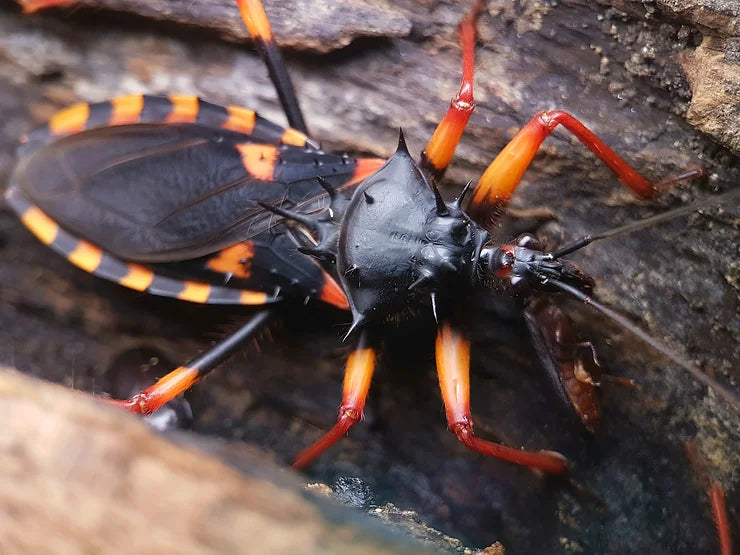
Psyttala horrida is among the largest assassin bugs in the world, reaching about 5cm, and is very hardy and easy to breed and reproduce in captivity.
They are characterized by an elongated head and a mouthpart called a rostrum, with which they inject a substance that dissolves the prey from within, then sucking its liquefied entrails.
This species is endemic to tropical West Africa, from Togo to Cameroon and occupy hollow tree trunks of dead trees or other similar shelters, also using verticality.
MOLTING
They grow by shedding their exoskeleton. The process that prepares the animal for molting is called premolt, and its duration varies depending on diet, temperature, and stage. When they enter premolt, they may lose their appetite for weeks, so if frequent meal refusals are noticed, feeding should not be forced; instead, one should wait. Once adult, they will stop molting. If molting goes wrong, they may have wrinkled wings or worse; in most cases, it is not serious and does not invalidate the specimen's life and reproductive capacity, but if the unsuccessful molt incapacitates the animal, its death will almost always be inevitable.
After molting, they will be completely red, and that is the most delicate phase, where their exoskeleton will be soft and will harden over hours, darkening.
HOUSING
TERRARIUM SIZE
They cohabit peacefully, although in cases of food scarcity or significant size differences among cohabitants, cannibalism may occur. For 5 pairs with nymphs, a 22L Samla box (a popular IKEA container) or alternatively any terrarium or box of similar or larger dimensions (40x30x30cm) works very well.
SUBSTRATE
As a substrate, you can use either high-quality Irish peat, with a pH of 3.5/4 maximum, or simple coco fiber or organic, unfertilized soil.
From experience, I would not use anything other than Irish peat, as its acidity makes mold proliferation very difficult, although you will still need to wash the furnishings when they are full of feces and remove any dead prey. It is necessary to include at least 4/5 cm of substrate to maintain humidity and provide adequate depth conducive to egg-laying, which will occur in the substrate.
The cleaning factor is easily solved by introducing springtails, Trichorhina tomentosa, or isopods (preferably all three) which will eat all food scraps, feces, and mold as much as possible, making hygienic maintenance almost zero.
TEMPERATURE
The optimal temperature for raising Psyttala horrida is 26/27 degrees Celsius, but they tolerate and live comfortably at household temperatures (minimum 20 degrees and maximum 30 degrees). The difference between keeping them at lower versus higher temperatures lies in the growth rate; in fact, lower temperatures like 20/23 degrees will slow down growth, appetite, and thus their metabolism, increasing their lifespan. Despite their resistance to a wide range of temperatures, it is always best to keep them at optimal temperatures to keep them active, resulting in more frequent reproductions.
HUMIDITY
Psyttala horrida, originating from the rainforests of West Africa, requires high humidity, around 80%. It will suffice to regulate by eye, keeping the substrate moist to the touch but not soaked or wet. Psytalla horrida primarily obtains water and liquids from their prey, but they do not disdain drinking from water droplets that slide down the walls or furnishings of the terrarium if misted.
DECORATIONS
They need oblique or vertical grips like tubular or half corks, branches, or plants to facilitate molting, which always occurs in a vertical position like mantises and stick insects, thus requiring grips.
If you wanted to provide them with a Bioactive terrarium (a more aesthetically pleasing option), I recommend plants such as pothos, pilea depressa, ficus pumila, pilea mollis.
SEXUAL DIMORPHISM
The difference between male and female is quite evident; indeed, the lower part of the female's abdomen is completely smooth, while males have a round outgrowth at the end of their abdomen.
REPRODUCTION
Reproduction occurs spontaneously in the presence of at least one sexually mature pair. Females lay eggs in the substrate a few weeks after mating. Incubation can last from four to six weeks depending on the temperature.
It is best to leave the eggs in the substrate, as this will provide the best possible incubation. However, if you wish to remove them, simply place them in a sufficiently ventilated box with a layer of moist substrate such as peat or moist vermiculite.
Newly hatched nymphs measure about five millimeters. They will have a red thorax and abdomen, a black head, and yellow legs. Growth lasts from six to eight months, and the young will undergo six molts to reach the adult stage. Adults live on average one to two years.
NYMPH REARING
Nymphs often cannibalize each other if not fed sufficiently, so they should be fed very frequently, especially during the first molts, at least once every other day. The best solution would be to separate them with others of their size in tall half-liter containers, like those for breadcrumbs, with an oblique or vertical cork inside to allow for molting. Once they reach the third or fourth molt, they can already be introduced with the rest of the adults, as cannibalism is greatly reduced at this stage.
FEEDING
In nature, they primarily feed on insects but do not disdain small vertebrates. In captivity, lateral cockroaches (Shelfordella lateralis) and crickets (Acheta domestica) are the best feeder insects for these assassin bugs. All other feeder insects such as locusts, other cockroaches, waxworms, mealworms, and superworms are also excellent. I have noticed that in adulthood, mealworms and superworms are almost always rejected and completely ignored. They are exceptional predators that prey on insects up to 3 times their size and tend to hunt in groups without much trouble, competing for or sharing prey, a truly interesting behavior to observe.
There are 2 ways to feed them: with tweezers, feeding them one by one, or by leaving several prey of different sizes freely in the terrarium so that they can hunt on their own, making their care almost maintenance-free, only needing to add prey in quantity when they run out and maintain the correct humidity. This latter method is effective only with prey that do not burrow or climb smooth surfaces, making them easily huntable. Nymphs can be provided with mini mealworms, mini crickets, mini lateral cockroaches, or any appropriately sized insect.
TEMPERAMENT AND VENOM
They are predominantly calm, slow-moving, and usually not aggressive. However, if handled or feeling threatened, they may sting or spray their venom (with an odor similar to vinegar) up to a distance of 40cm. The sting is very painful, but the venom is not fatal or dangerous to humans. If the venom is sprayed into the eyes, it would cause severe irritation and temporary blindness.